Streets, Parks, and Scores: How New York's Urban Landscape Became a Composer's Canvas
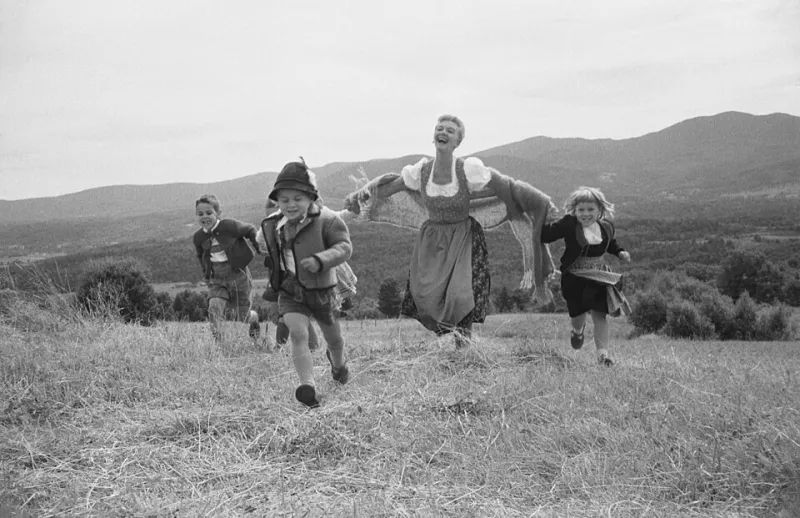
Photo: Toni Frissell / Adam Cuerden, Public domain, via Wikimedia Commons
New York has always been more than a backdrop. For composers who have passed through its terminals, taken up residence in its tenements and towers, or simply paused on a bridge to watch the East River catch the morning light, the city functions as something closer to a collaborator — insistent, generous, and entirely without sentiment. The music that has emerged from this relationship is among the most distinctive in the American canon, shaped not merely by the cultural institutions that commissioned it but by the very ground beneath the composer's feet.
The Harbor as Overture
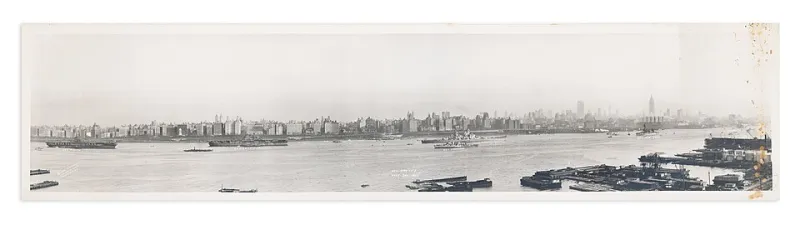
For much of the nineteenth and early twentieth centuries, New York was the first American experience that visiting European composers encountered. Antonín Dvořák, who arrived in 1892 to lead the National Conservatory of Music on East 17th Street, famously drew upon the spiritual and folk traditions he encountered here, but the city's physical presence was equally formative. His walks through the neighborhoods of lower Manhattan and his documented visits to the piers along the Hudson shaped a sense of vast, open possibility that permeates his American compositions. The harbor, with its ceaseless traffic and its horizon suggesting elsewhere, offered a geographical counterpart to the expansive melodic lines that characterize his New World Symphony.
The composer himself noted, in correspondence preserved at the National Conservatory archives, that the noise and movement of the city did not distract him so much as animate him. New York, he suggested, was never silent in the way that the Bohemian countryside could be silent. It hummed at a frequency that demanded a response.
Central Park and the Grammar of Respite
If the harbor represented arrival and aspiration, Central Park offered something more introspective. The park has served as a compositional sanctuary for generations of musicians, a green interruption in the city's relentless grid where the mind could, as one contemporary composer put it, "finally hear itself think."
Contemporary composer and NY Classical Club artist-in-residence Mara Solis describes her relationship with the park in almost architectural terms. "There is a specific quality of light in the Ramble in late October," she explains, "where the canopy thins and you begin to see the skyline through the branches. That layering — nature in the foreground, the city asserting itself in the distance — gave me the structural idea for the second movement of my string quartet. Two voices that are entirely distinct but that cannot exist without each other's presence."
This dynamic of tension and coexistence is one that recurs throughout the music composed in and about New York. The city rarely permits a single, uncontested voice. It insists on counterpoint.
Brooklyn's Waterfront and the Postwar Avant-Garde
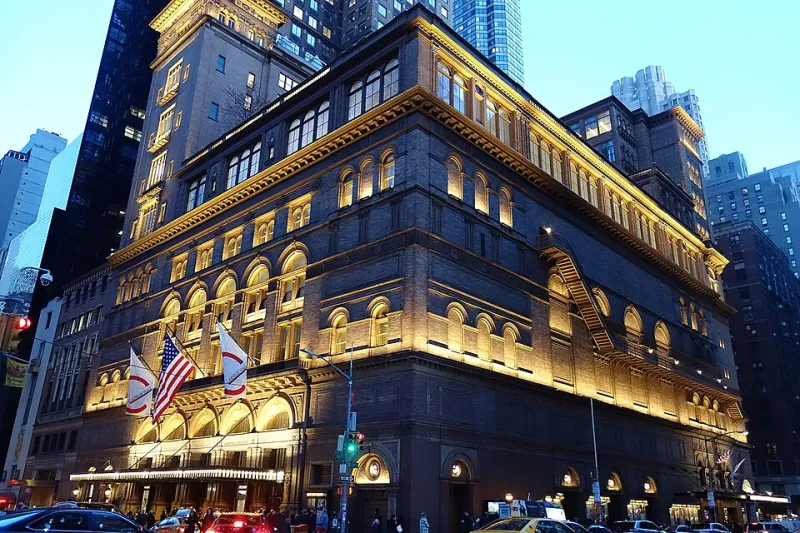
By the mid-twentieth century, the creative center of gravity in New York's classical world had begun to shift. While Carnegie Hall and Lincoln Center anchored the established tradition in Manhattan, composers working in a more experimental vein were finding inspiration in the industrial landscapes of Brooklyn and lower Manhattan. The warehouses along the Brooklyn waterfront, the elevated rail lines, the particular acoustic quality of a loft space with exposed brick — these environments informed a generation of composers who were actively seeking to break with the concert hall aesthetic.
The influence of place on sonic imagination is perhaps most legible in this period. Morton Feldman, who spent decades in the city and whose music bears the unmistakable imprint of its scale and pace, spoke frequently about the visual arts community he inhabited in lower Manhattan and the way that the physical dimensions of a canvas or a room shaped his sense of musical duration. New York did not merely inspire his music; it provided the perceptual framework within which that music was conceived.
The Bronx, Queens, and the Question of Whose New York
A candid accounting of New York's compositional geography must acknowledge that the city's influence has not been evenly distributed across its five boroughs. The classical music world has historically centered its attention on Manhattan, and the neighborhoods of the Bronx, Queens, Brooklyn, and Staten Island have received considerably less consideration as sites of serious compositional activity — a disparity that several contemporary composers are working to correct.
Composer and educator Daniel Osei, who grew up in the Bronx and now teaches at a conservatory in upper Manhattan, is explicit about how his home borough shaped his musical sensibility. "The Bronx has an acoustic identity that is completely its own," he says. "The elevated train, the way sound moves between the buildings on the Grand Concourse, the particular density of street life on a Saturday afternoon — I carry all of that in my ear. When I sit down to write, those sounds are in the room with me."
Osei's recent orchestral work, premiered last season at a concert series in the South Bronx, drew directly on field recordings he made in his neighborhood over the course of a year. The result was music that felt, to many listeners, like a portrait of a place that the classical tradition had long overlooked.
The Skyline as Score
There is a persistent metaphor among New York composers that equates the city's skyline with a musical score — a horizontal line punctuated by vertical structures of varying height and density, each one suggesting a different duration, register, and timbre. It is a romantic conceit, perhaps, but not an entirely frivolous one.
The built environment of Manhattan, in particular, imposes a set of spatial and temporal relationships that inevitably condition the perception of anyone who inhabits it. The compression of the grid, the verticality of the architecture, the way that a single block can move from residential quiet to commercial cacophony in the space of a few steps — these are experiences that train the ear and the imagination in specific ways. Composers who spend their days navigating this environment develop, almost inevitably, a heightened sensitivity to contrast, density, and the unexpected juxtaposition of sonic registers.
A Living Conversation
What distinguishes the most compelling music to emerge from New York is not merely that it references the city or incorporates its sounds, but that it engages in a genuine dialogue with the place. The city asks questions — about scale, about pace, about the relationship between the individual and the collective — and the music answers them, however obliquely.
For patrons and listeners who attend concerts in this city, there is an additional dimension of pleasure available in recognizing these conversations. The string quartet that seems to argue with itself, the orchestral passage that surges and retreats like traffic on a crosstown street, the solo piano piece that finds stillness in the midst of apparent chaos — these are not accidental qualities. They are the traces of a place that has been, for more than a century, one of the world's most fertile environments for musical creation.
New York's geography is not merely a setting. It is, for the composers who know it well, a language.