Power, Patronage, and the Podium: How Classical Music Built New York's Cultural Empire
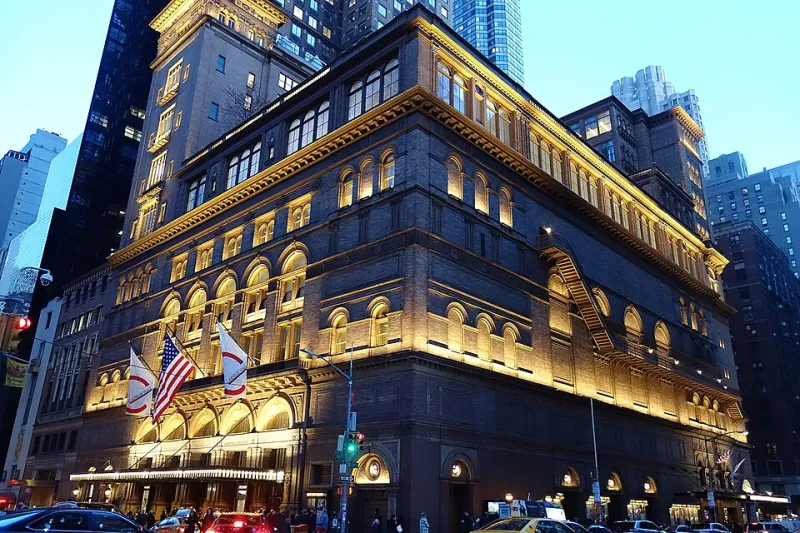
Photo: Tdorante10, CC BY-SA 4.0, via Wikimedia Commons
Long before hedge funds and tech fortunes reshaped Manhattan's skyline, classical music served as the ultimate currency of ambition for New York's most consequential figures. From the Gilded Age drawing rooms of Fifth Avenue to the rehearsal halls of Lincoln Center, composers, conductors, and philanthropists wielded the classical tradition as an instrument of institutional power. Their legacies endure in ways that most concertgoers never pause to consider.
The Gilded Stage: Music as a Marker of Civilization
When Andrew Carnegie opened his eponymous hall in 1891, the gesture was not purely philanthropic. It was strategic. Carnegie understood, as did many of his contemporaries, that underwriting great music conferred a kind of civic legitimacy that no amount of steel production ever could. To sponsor a symphony was to announce that one belonged not merely to the merchant class, but to something more refined—something lasting.
This calculus shaped the entire architecture of New York's classical music world. The Vanderbilts, the Rockefellers, and the Astors did not simply attend concerts; they commissioned them, endowed them, and in doing so, transformed their family names into permanent features of the city's cultural geography. Carnegie Hall itself stands as perhaps the most durable monument to this fusion of wealth and artistic aspiration, a building whose very existence was predicated on the belief that music could elevate a nation still finding its footing on the world stage.
What is often overlooked, however, is how deliberately these patrons curated their associations. European repertoire was favored not merely out of aesthetic preference, but because it carried the weight of Old World prestige. To present Brahms or Wagner in New York was to situate the city—and by extension oneself—within a broader tradition of Western civilization. It was cultural positioning of the most sophisticated order.
Leonard Bernstein and the Politics of the Podium
No figure in New York's classical history more brilliantly understood the intersection of art and influence than Leonard Bernstein. His appointment as Music Director of the New York Philharmonic in 1958 was not simply a triumph of talent; it was a seismic cultural moment. Here was a Brooklyn-born son of Ukrainian Jewish immigrants ascending to the most prominent podium in American music—and he was acutely aware of what that ascent meant.
Bernstein's tenure at the Philharmonic was marked by an almost missionary zeal to democratize the classical tradition while simultaneously elevating it. His celebrated Young People's Concerts, broadcast nationally on CBS, reached millions of American households and reframed classical music as an intellectually exciting, emotionally accessible art form rather than a rarefied pursuit for the privileged few. Yet Bernstein was equally comfortable in the salons of the Upper West Side, cultivating relationships with politicians, intellectuals, and cultural arbiters who could amplify his vision.
His famous—and famously controversial—fundraiser for the Black Panthers in 1970 illustrated precisely how thoroughly he had woven music into the fabric of social and political life. Whether one agreed with his politics or not, the episode demonstrated that Bernstein had transformed the conductor's role from that of a mere musical interpreter into something closer to a public intellectual with genuine institutional leverage.
Bernstein's legacy at the Philharmonic, and indeed across the broader landscape of American classical music, cannot be separated from this understanding of power. He used the concert hall as a platform, the orchestra as a megaphone, and the classical tradition as a shared language through which he could address the great questions of his era.
The Philanthropic Architecture of Lincoln Center
The creation of Lincoln Center for the Performing Arts in the 1960s represents perhaps the most ambitious exercise in cultural institution-building that New York has ever undertaken. It was not, at its core, an artistic project. It was an urban renewal initiative, a real estate venture, and a statement of civic ambition that happened to be clothed in the language of high culture.
John D. Rockefeller III, who chaired the center's founding committee, envisioned Lincoln Center as a mechanism for stabilizing the Upper West Side while simultaneously projecting an image of American cultural sophistication during the Cold War. The timing was not coincidental. As the Soviet Union promoted its own extraordinary classical music tradition—the Bolshoi, the Kirov, the great Soviet pianists and violinists—American cultural diplomats recognized that a world-class performing arts complex could serve as a powerful symbol of democratic achievement.
The families and foundations that poured money into Lincoln Center were not simply supporting the arts. They were shaping the city's identity, negotiating its international reputation, and ensuring that their own names would be inscribed on its buildings for generations. The Avery Fisher Hall renovation, the Alice Tully Hall redesign, the David Geffen Hall rebranding—each represents a fresh chapter in this ongoing story of music and institutional power.
Women Patrons and the Unwritten History
Any honest account of classical music's role in building New York's institutions must reckon with the outsized—and frequently unacknowledged—contributions of women philanthropists. In an era when women were largely excluded from formal positions of corporate or political power, the patronage of music offered an avenue for genuine influence.
Figures such as Isabella Seligman, Elizabeth Sprague Coolidge, and later, Brooke Astor, channeled considerable fortunes and social capital into the support of orchestras, chamber ensembles, and music education programs. Their salons functioned as informal clearinghouses for artistic talent, connecting European émigré musicians—many of whom arrived in New York fleeing fascism in the 1930s and 1940s—with American audiences and institutions.
This network of women patrons helped ensure that New York absorbed an extraordinary influx of musical genius during the mid-twentieth century. The ripple effects were profound: conservatories were enriched, orchestras were strengthened, and the city's reputation as a world capital of classical music was cemented in ways that no single conductor or composer could have achieved alone.
The Legacy We Inhabit
For those of us who attend concerts at Carnegie Hall or Lincoln Center today, it is worth pausing to consider the layered history beneath our feet. The seats we occupy, the institutions we support, the repertoire we cherish—all of it bears the imprint of men and women who understood that music was never merely music. It was strategy, it was identity, and it was power.
New York's classical tradition did not emerge organically from some democratic wellspring of shared cultural longing. It was built, deliberately and sometimes ruthlessly, by individuals who saw in the concert hall a mirror of their own ambitions. That knowledge need not diminish our experience of the music itself. If anything, it enriches it, reminding us that the art we love has always been entangled with the full complexity of human aspiration.
The NY Classical Club is proud to carry forward a tradition that has meant so much to this city—and to the remarkable, complicated people who made it what it is.