Crossed Out, Reconsidered, Reborn: What New York's Archives Reveal About the Making of Great Music

Photo: Unknown, Public domain, via Wikimedia Commons
The concert hall presents music as a fait accompli. The lights dim, the ensemble enters, and a masterwork unfolds with the authority of something inevitable — as though Brahms or Bartók had simply transcribed a vision whole from the ether. Yet behind the velvet curtain of that polished performance lies a far more turbulent story, one written in pencil scratches, ink blots, and margins crowded with second thoughts. For those willing to look, New York's extraordinary network of archival collections offers a rare and humbling window into the actual labor of composition.
The City as Custodian of Creative Struggle
New York has long served as a repository for the working documents of musical history, a role it has earned through decades of institutional investment and the generosity of estates, donors, and scholars. The New York Public Library for the Performing Arts at Lincoln Center houses one of the most significant collections of musical manuscripts in the world, encompassing sketches, correspondence, and annotated scores that span centuries and continents. The Morgan Library & Museum on Madison Avenue holds treasures of a different order — autograph manuscripts of extraordinary intimacy, including materials that illuminate the compositional methods of composers from Mozart to Mahler.
Together, these institutions constitute something remarkable: a city-wide archive of artistic uncertainty. And uncertainty, it turns out, is the very medium in which greatness is forged.
What the Sketches Actually Show
Visitors who have had the privilege of examining manuscript materials firsthand — whether in a supervised reading room or through a carefully curated exhibition — often report a sensation bordering on disorientation. The composer one thought one knew, the voice one had internalized through hundreds of hours of listening, suddenly appears tentative, even confused. Themes that sound inevitable on the concert stage were, at an earlier stage, something quite different: longer, shorter, harmonically uncertain, rhythmically awkward.
The sketch materials associated with Beethoven's compositional process, portions of which have passed through New York collections and exhibitions over the years, offer perhaps the most instructive case study. Beethoven was a notoriously relentless reviser. His sketchbooks — dense, difficult to read, filled with false starts and marginal corrections — demonstrate that even the opening motif of the Fifth Symphony, arguably the most famous four notes in Western music, was not arrived at casually. Earlier sketches suggest alternative rhythmic configurations, different harmonic contexts, a searching quality that the finished work entirely conceals.
This is not a diminishment of Beethoven's genius. It is, rather, a clarification of what genius actually involves.
American Composers and the Archive
New York's archival wealth is not confined to the European canon. The city's institutions hold substantial materials relating to American composers whose careers unfolded here — figures who shaped the sound of twentieth-century music in ways that are still being fully reckoned with.
The papers of Leonard Bernstein, portions of which are accessible through the Library of Congress while related materials circulate through New York institutions and exhibitions, reveal a composer of extraordinary ambition who was also, at times, a composer of extraordinary doubt. Drafts associated with West Side Story — a work whose cultural footprint in this city needs no elaboration — show Bernstein and his collaborators negotiating the tension between the work's popular ambitions and its classical aspirations with a candor that the finished score understandably suppresses.
Similarly, the archival legacy of Aaron Copland, another defining voice of American music with deep New York roots, demonstrates how a composer's public persona — in Copland's case, the lucid, open-hearted voice of the American prairie — was constructed through considerable compositional effort rather than simply expressed. Rejected passages, transposed sections, and restructured movements tell a story of aesthetic decision-making that enriches one's understanding of works like Appalachian Spring considerably.
Reading the Revisions
For the engaged listener, developing even a basic familiarity with archival materials — whether through exhibition visits, published facsimiles, or the growing body of scholarly literature that draws on manuscript sources — offers genuine rewards. The practice of reading revisions trains the ear to hear finished works with greater attentiveness.
When one knows, for instance, that a particular passage in a string quartet was originally scored for a different combination of instruments, one listens differently to the version that survived. When one understands that a symphony's slow movement was substantially reconceived after the composer heard an early run-through, the movement's emotional architecture becomes more visible. The finished work does not become less beautiful; it becomes more so, because one perceives in it the weight of the choices that produced it.
This is one reason that institutions such as the NY Classical Club place such emphasis on programming that contextualizes the music performed. Pre-concert lectures, annotated program notes, and curated conversations with scholars and performers can bring the archival dimension of a work to life for audiences who may never set foot in a reading room. The goal is not to burden the listening experience with musicological apparatus, but to deepen it — to invite audiences into a more complete relationship with the music they love.
The Ethics and Pleasures of Incompletion
Not every archival discovery is a source of comfort. Occasionally, what the manuscripts reveal is that a beloved work was completed under conditions of considerable compromise — that illness, financial pressure, or a publisher's deadline forced a composer to abandon a more ambitious conception. There are works in the repertoire that scholars now understand to be, in a meaningful sense, unfinished, even though they were published and performed as complete during the composer's lifetime.
How one responds to this knowledge is a matter of personal philosophy. Some listeners find it troubling; the idealized object is revealed as contingent. Others find it liberating — evidence that the art form is, at its root, a human endeavor, subject to all the constraints and imperfections that humanity implies.
What seems clear is that the archive does not undermine the canon. It deepens it. The masterpieces that have endured did so not because they were effortlessly produced, but because the effort invested in them was, in some cases, heroic.
An Invitation to Look Closer
New York offers its residents and visitors an unparalleled opportunity to engage with this dimension of musical life. The reading rooms are open. The exhibitions are mounted regularly. The published scholarship is richer than it has ever been. For the listener who wishes to move beyond passive appreciation into genuine understanding, the archive is not an intimidating scholarly precinct — it is an invitation.
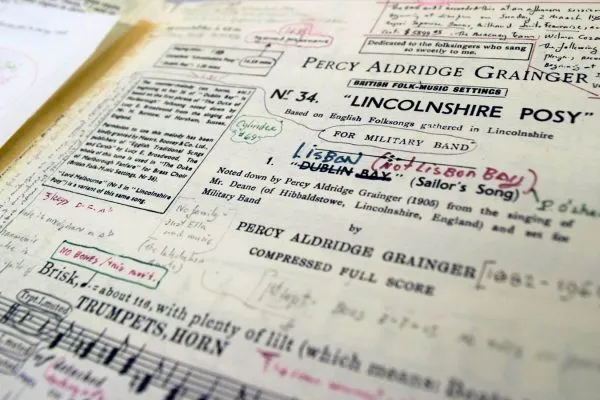
To see a composer's hand cross out a phrase, reconsider it, and ultimately restore it in a different key is to witness something that no performance can fully convey: the mind in the act of creation, uncertain and alive. That experience, available in the heart of this city, is one of the quieter privileges of living in New York.