After the Last Note: The Art, Ritual, and Power of the Classical Encore
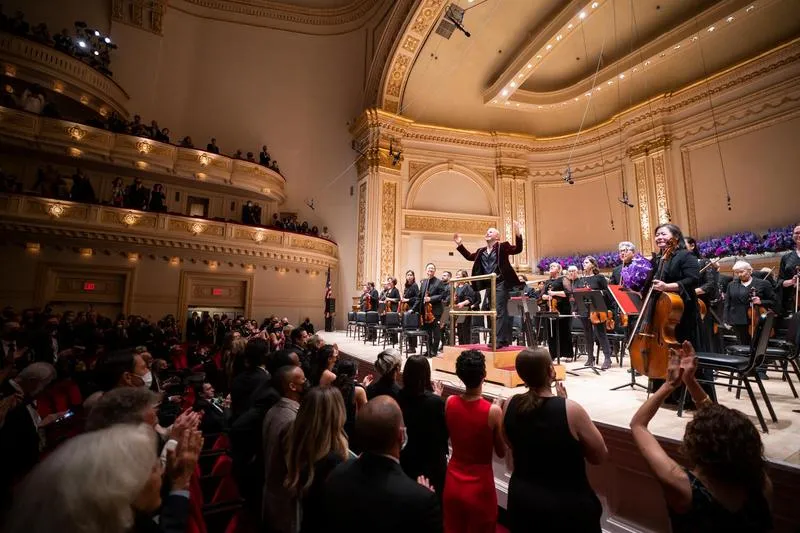
Photo: classical musician taking bow on concert stage Carnegie Hall applause, via media.wnyc.org
The house lights remain low. The final chord of a Brahms symphony has dissolved into the rafters of David Geffen Hall, and yet the audience will not release the evening. Applause surges, feet stamp against the parquet, and the conductor — perhaps feigning reluctance, perhaps genuinely moved — returns to the podium one final time. What follows belongs to no printed program, no season brochure, no advance review. It belongs entirely to the room.
This is the encore, and for all its apparent informality, it is among the most carefully considered gestures in classical performance.
A Tradition With Deep Roots
The word itself arrives from the French, meaning simply "again" — a demand as old as public performance. In the eighteenth and nineteenth centuries, encores were neither optional nor modest. Audiences at the Paris Opéra and the theaters of Vienna routinely compelled performers to repeat entire movements, sometimes multiple times in a single evening. Beethoven reportedly grew exasperated by the practice; Rossini, characteristically, embraced it. By the time the great virtuoso tradition of the nineteenth century reached its full flowering — through Liszt, Paganini, and Clara Schumann — the encore had evolved from a contractual obligation into a form of theatrical communion between soloist and crowd.
In New York, the tradition took on particular character as Carnegie Hall established itself in the early twentieth century as the proving ground for international artists. To receive a Carnegie encore demand was to receive a verdict. Critics noted not merely what an artist played as an encore, but how they played it — whether the choice revealed generosity, wit, or a deeper understanding of what the audience had just experienced.
The Philosophy Behind the Choice
Ask any working soloist in New York today, and you will find that encore selection is anything but casual. Pianists, violinists, and singers maintain private repertoires of encore pieces that may number in the dozens — each one suited to a different emotional register, a different kind of evening, a different quality of applause.
The calculus is genuinely complex. An encore must not overshadow the main program, yet it cannot feel perfunctory. It should offer contrast without jarring discontinuity. A recital concluding with a late Schubert sonata might call for something intimate and searching — a Chopin nocturne, perhaps, or a Bach sarabande. An evening of Prokofiev and Bartók might invite something more playfully unexpected: a ragtime fragment, a folk melody dressed in concert clothes.
For orchestral conductors, the considerations multiply. Selecting an encore for a full ensemble requires weighing the stamina of a hundred musicians at the end of a demanding program, the capabilities of any soloists who may still be on stage, and the acoustical identity of the hall itself. Some conductors favor short, exuberant pieces — a Dvořák Slavonic Dance, a Johann Strauss waltz — that send audiences into the night with something bright and immediate. Others prefer a more meditative close, allowing the emotional weight of the main program to linger rather than dissipate.
Encores That Defined Careers
Certain encores have passed into the mythology of New York concert life. Vladimir Horowitz's returns to Carnegie Hall — particularly his celebrated 1965 comeback recital — were as famous for their encores as for anything on the printed program. His performance of the Moszkowski Étude in F major, offered almost as an afterthought, left critics struggling for language. The encore, in that instance, became the headline.
Itzhak Perlman has long been associated with the Kreisler miniatures he favors as encores — pieces that transform Carnegie's vast stage into something resembling a private salon. Yo-Yo Ma's habit of offering Bach solo suites as encores, even after full concerto performances, has been described by more than one observer as a kind of spiritual reorientation, a reminder of where the music ultimately lives.
More recently, New York audiences have witnessed a generation of younger soloists using the encore as a deliberate statement of identity. Pianists have offered original compositions. Vocalists have reached across genre boundaries to include spirituals, art songs from neglected traditions, or newly commissioned miniatures. The encore, in these instances, becomes a manifesto — a brief declaration of artistic values that the formal program, with its institutional expectations, might not easily accommodate.
The Democratizing Moment
There is something genuinely leveling about the encore ritual that deserves more attention than it typically receives. For the duration of the printed program, the relationship between performer and audience operates within a formal hierarchy. The artist has prepared; the audience has arrived to receive. The music unfolds according to a predetermined architecture, and the listener's role — however active internally — is largely one of attentive reception.
The encore disrupts this arrangement in productive ways. The audience, through sustained and specific applause, has effectively commissioned a performance. The artist, in responding, acknowledges a reciprocal obligation. What follows is less a performance in the conventional sense than a negotiation — a moment in which the invisible contract between stage and hall becomes briefly, beautifully visible.
This dynamic carries particular significance in New York, where concert audiences are among the most knowledgeable and assertive in the world. A New York encore demand is not merely polite appreciation; it is an informed request from listeners who understand the tradition they are participating in. When a Carnegie Hall audience refuses to release a soloist after four curtain calls, both parties understand the stakes.
When the Encore Fails — and What That Reveals
Not every encore lands. Musicians speak candidly, in private, of encores that misjudged the room — pieces too light for an audience still processing something profound, or too weighty for a crowd that simply wanted to celebrate. There are encores that feel mechanical, offered out of obligation rather than genuine response, and audiences in New York are rarely deceived by the difference.
In this sense, the encore functions as a kind of truth test. A performer who has genuinely connected with an audience will find the encore flowing naturally from that connection. One who has delivered a technically accomplished but emotionally remote performance may find the encore — however well-chosen on paper — falling slightly flat. The encore cannot be faked, or at least not convincingly.
A Living Ritual
As classical music continues to examine its own conventions — questioning dress codes, rethinking program notes, experimenting with venue and format — the encore stands out as a tradition that has largely resisted institutional interference. Concert presenters do not program encores. Critics do not review them in advance. Audiences cannot request specific pieces (though they occasionally try). The encore remains, in an art form that sometimes struggles to project spontaneity, one of its most genuinely unscripted gestures.
For those of us who attend concerts regularly in New York, the encore is often what we remember longest. Not because it is necessarily the finest music of the evening, but because it is the moment when the performance exhales — when the formal architecture gives way to something more intimate, more direct, and more honest. It is the moment when a great artist stops performing for a program and begins, however briefly, to simply play.
And in that simplicity, something essential about music itself becomes briefly, unmistakably clear.