Composing on Their Own Terms: How Digital Tools Are Reshaping Who Defines Classical Music

Photo by Photo by Clay Banks on Unsplash on Unsplash
For most of classical music's modern history, the path from composer to audience ran through a series of formidable gatekeepers: publishing houses, recording labels, orchestra programming committees, and the critical establishment that adjudicated what was worthy of preservation. The system was not without its merits — it produced extraordinary art and sustained institutions that remain the envy of the world. But it also left entire categories of composers outside the frame, their work undocumented, underperformed, or simply unknown.
Something is changing. Quietly, and then all at once, digital infrastructure has begun to dismantle the architecture of exclusion that governed classical music's ecosystem for well over a century. The consequences for New York's compositional community — one of the most diverse and intellectually restless in the world — are only beginning to be understood.
The Old Architecture and Its Silences
To appreciate what is shifting, it helps to understand what was in place. The classical music industry, particularly in America, operated on a model of institutional endorsement. A composer's legitimacy was largely conferred by the organizations willing to invest in their work: major orchestras, prestigious festivals, the handful of publishers whose catalogs defined the repertoire. For composers who fell outside the social and cultural networks that fed those institutions — women, composers of color, those working in idioms deemed insufficiently serious — the barriers were not merely procedural. They were systemic.
New York, for all its cultural richness, was no exception. The city's storied institutions produced remarkable programming, but the canon they reinforced often reflected the tastes and assumptions of a remarkably homogeneous curatorial class. Composers whose biographies, aesthetics, or identities did not align with prevailing expectations found their access to audiences severely curtailed, regardless of the quality of their work.
A New Infrastructure of Distribution
The emergence of streaming platforms — Spotify, Apple Music, and more specialized services such as Idagio and Primephonic's successors — has fundamentally altered the economics of reaching a listener. Where once a composer required the imprimatur of a major label to achieve meaningful distribution, it is now possible to upload a recording of a new work and make it available to listeners across the globe within hours.
This shift is not merely logistical. It is philosophical. The decision about what enters the public ear is no longer exclusively the province of institutional gatekeepers. Composers themselves, working with independent producers and self-funded recording projects, can now build audiences on their own terms.
Several New York-based composers have embraced this model with striking results. Emerging voices working at the intersection of contemporary classical writing and vernacular American traditions have found that direct-to-listener distribution allows them to cultivate communities of engaged listeners who might never have encountered their work through conventional channels. Social media platforms — particularly Instagram and YouTube — have proven especially effective for composers willing to offer audiences a window into the compositional process itself: sketches, revisions, rehearsal footage, and candid discussion of the ideas animating a given work.
The Question of the Canon
Yet the democratization of distribution raises a question that is more complex than it might initially appear: what happens to the canon when everyone can publish?
For some observers, the fragmentation of classical music's curatorial authority is cause for concern. The canon, however imperfect, served a consolidating function — it provided a shared repertoire against which performers, scholars, and listeners could orient themselves. Without some mechanism of collective discernment, the argument goes, the tradition risks dissolving into an undifferentiated archive, vast and navigable only by algorithm.
For others, this anxiety misreads the nature of the problem. The canon was never a neutral document. It was a product of specific historical choices made by specific people with specific interests. The question is not whether to have a canon, but who participates in shaping it — and on what grounds. Digital tools do not abolish curatorial judgment; they distribute it more widely and make its exercise more visible.
This tension plays out with particular intensity around the recovery of historically marginalized composers. Scholars and performers in New York have spent recent years excavating the work of figures whose contributions were systematically overlooked: Black composers of the early twentieth century, women whose manuscripts gathered dust in institutional archives, immigrant composers whose cultural idioms were deemed peripheral to the American tradition. Digital platforms have given this recovery work an audience it could not previously access.
Engagement as Artistic Practice
What is perhaps most striking about the current moment is the degree to which a number of composers have come to regard audience engagement itself as a dimension of their artistic practice — not a concession to commercial pressure, but a genuine extension of compositional thinking.
Several New York composers have begun building what might be described as compositional communities: groups of listeners who follow the development of a work in real time, respond to questions posed via social media, and attend performances that feel less like presentations than conversations. This model has antecedents in the downtown experimental scene that flourished in Manhattan's lofts and churches during the 1970s and 1980s, but it has been given new reach and new tools by digital infrastructure.
The implications for the relationship between composer and institution are significant. When a composer has cultivated a direct relationship with several thousand engaged listeners, the leverage that traditionally accrued to institutional programmers is recalibrated. The orchestra or presenting organization is no longer the sole conduit to an audience; it becomes one option among several.
What New York's Institutions Stand to Gain
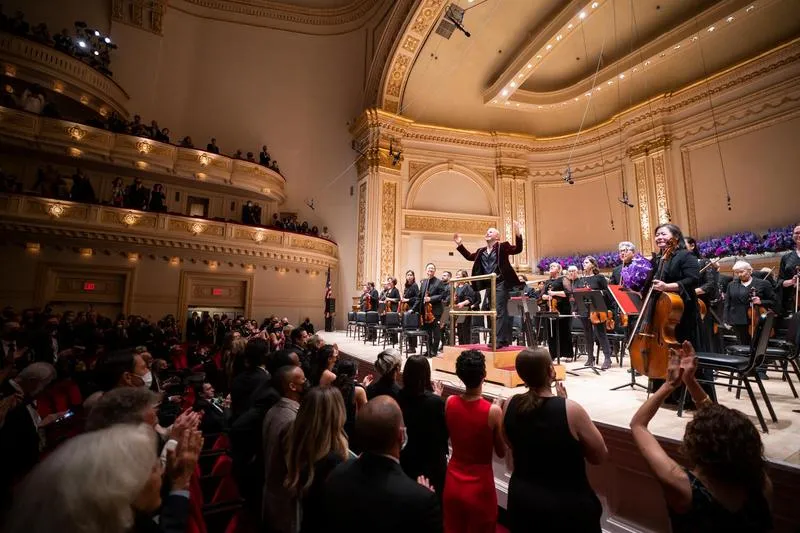
It would be a mistake to frame this transformation as a conflict between composers and institutions. New York's great classical organizations — its orchestras, opera companies, and chamber music societies — remain irreplaceable for the scale, quality, and cultural weight of performance they can provide. A symphony premiered by a major orchestra in a world-class hall carries a different kind of authority than one released independently, and composers know this.
The more productive framing is one of complementarity. Digital tools allow composers to build the kind of sustained audience relationships that institutions are often poorly equipped to cultivate. Institutions, in turn, can amplify and legitimate work that has already demonstrated its resonance. The pipeline, in other words, need not flow exclusively from institution to audience. It can flow in both directions.
For New York's classical community — patrons, programmers, and devoted listeners alike — this moment offers an invitation. The canon is being written, as it always has been, by those willing to make the case for what matters. The difference is that the conversation is now considerably wider, and considerably louder, than it has ever been. Those who engage with it seriously, rather than lamenting the noise, are likely to find it one of the more rewarding developments in American classical music in a generation.