The Comfort of the Familiar: Why New York's Concert Halls Keep Circling Back to the Canon
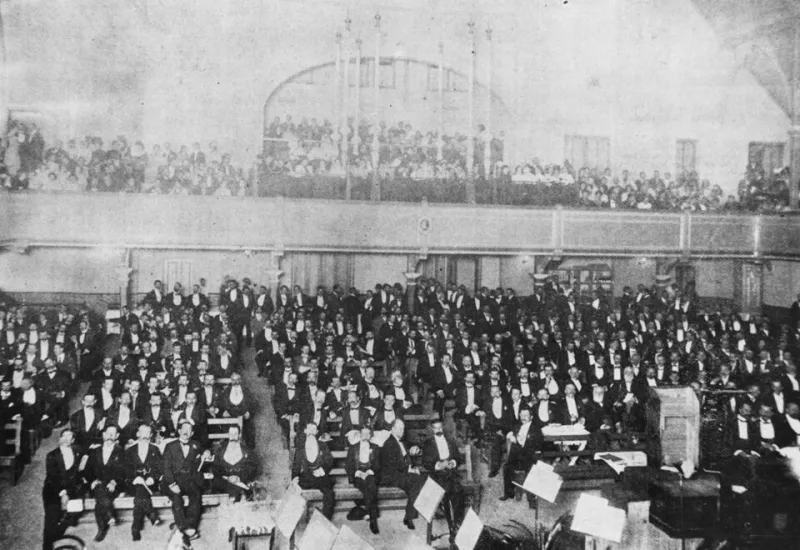
Photo: Contributor(s): Queenslander (Brisbane, Qld.: 1866-1939), Public domain, via Wikimedia Commons
The Line You Can Hum
Every New York season announcement arrives with a certain rhythm of recognition. There will be a Beethoven symphony cycle somewhere. There will be a Rachmaninoff concerto attached to a marquee soloist. There will be a Dvořák "New World," a Tchaikovsky Fifth, a Ravel "Boléro" placed carefully near the end of an evening so the audience leaves humming. These works are not merely popular. They are structural — the load-bearing walls of the concert calendar.
And then there is the other column: the American premiere, the rediscovered symphony by a composer who died in obscurity, the piece written in 2019 that receives a committed performance on a Thursday, a warmer reception on Friday, and no third hearing anywhere in the city for the next decade.
This asymmetry is not a secret and it is not new. What deserves more scrutiny is the assumption beneath it — that familiar music sells and unfamiliar music does not, and therefore that the ratio is simply arithmetic. That assumption is largely true and almost entirely incomplete.
How a Warhorse Gets Booked
Programmatic conservatism has a rational core. A symphony orchestra carries fixed costs measured in the millions, a subscription base that skews older, and a marketing department that must fill a hall on a Tuesday in February. Familiar repertoire is legible. It can be advertised in a single line. It has recordings, associations, and a title that a listener who has never attended a concert may still recognize. It offers the presenter a hedge against the unknown.
There is also a genuine service argument, one that deserves more respect than it usually receives. A great symphony heard live for the first time is not a lesser experience for being familiar to others. Every season brings new listeners into these halls, and the canon — whatever its problems — is the doorway most of them walk through. One does not build an audience by handing a newcomer an eighty-minute premiere and a program note.
The Cost of the Unfamiliar
The trouble is what happens after the door. A work that receives one performance is not really entering the repertoire; it is visiting it. Audiences cannot develop familiarity with music they hear once, and the absence of familiarity is then cited as evidence that the music does not connect. The logic becomes circular: unfamiliar pieces are programmed sparingly, receive few repetitions, make a modest impression, and are judged not to warrant repetition.
Compare the treatment of a new work with the treatment of a Beethoven symphony in its first decades, when it too was difficult, controversial, and dependent on repeated hearings to settle into listeners' ears. The canon was not discovered. It was built, by institutions that committed to the same difficult music across many seasons until it became second nature.
What Repetition Actually Does
There is a defensible case for cycles, anniversaries, and returns. Repetition is how listening deepens. A symphony heard for the fifth time reveals its architecture; a concerto heard for the tenth reveals its jokes. New York audiences are unusually well served in this respect: the sheer density of the city's concert life means a committed listener can hear the same masterpiece three times in a season under three different conductors, and learn more from that triangulation than from any single revelation.
But repetition performed by an institution is different from repetition chosen by a listener. When the same twenty works anchor every season, the canon stops functioning as a shared inheritance and starts functioning as a catalogue of guaranteed inventory. The tradition is not renewed by being recited. It is renewed by being extended.
A Reasonable Wager
None of which argues for abandoning the warhorses, or for pretending that a hall full of people hearing a familiar adagio is somehow a failure of curiosity. The point is narrower: repetition should be a strategy, not a default. There is a middle path that some New York ensembles have already found — pairing a familiar symphony with a shorter unfamiliar companion piece, reviving a neglected work across several seasons rather than once, treating a newly commissioned score as a recurring voice rather than a single event.
Audiences are less fragile than the arithmetic assumes. They will tolerate a challenging first half if the second half gives them something to hold. What they will not do, over time, is keep paying for a tradition that seems to have stopped asking anything new of itself. The canon's greatest gift is that it taught several generations how to listen. The question worth asking, as the 2026–27 season takes shape, is what the next lesson is supposed to be.