The Aisle Seat: What New York's Front-of-House Staff Hear Before the Critics Do
Photo: Bain News Service, publisher, Public domain, via Wikimedia Commons
The Room Before the Room
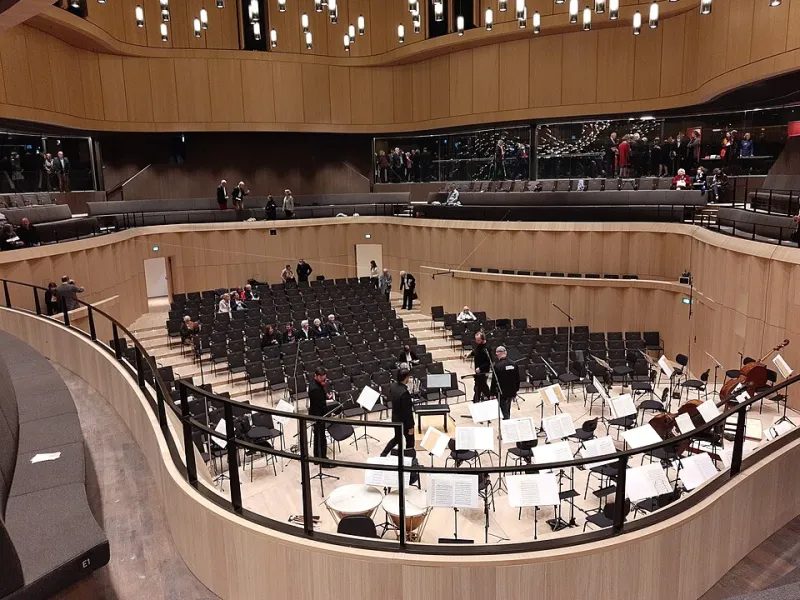
At 7:12 on a Tuesday evening in October, the doors of a Lincoln Center recital hall swing open and six hundred people file past a woman named Denise, who has been taking tickets there for eleven seasons. She is not, by job description, a listener. She scans barcodes, points toward the restrooms, and quietly redirects a man who has mistaken the orchestra level for the balcony. But ask her how the concert went and she will tell you something no review will print: that the audience was restless from the first movement, that a cluster of subscribers in the sixth tier talked through the slow movement, and that the applause after the cadenza arrived a half-beat early from the second balcony, and that the soloist heard it.
Front-of-house staff occupy the strangest vantage point in the hall. They hear everything, they see everything, and they are paid to look away. Ushers, house managers, ticket takers, and the volunteers who hand out programs at Merkin Hall and the Kaufmann Concert Hall and the many smaller rooms across the boroughs form a kind of shadow audience — one that experiences the performance from the aisle rather than the seat, and that accumulates, season after season, an ear for things the rest of us miss.
What Attention Actually Sounds Like
Critics write about interpretation. Front-of-house staff notice attention, which is a different and arguably more revealing phenomenon. A hundred people shifting in their seats produces a sound like wind through dry leaves, and experienced ushers can date the exact moment a performance loses its grip on a room.
"You can hear it before you can see it," says a house manager who has worked Broadway-adjacent concert venues and a major university hall over a fifteen-year career. "There's a point where the coughing starts to cluster, and it isn't random. It clusters around the same passages. It's not that people are bored. It's that the music stopped asking anything of them for a minute, and their bodies noticed before their minds did."
The reverse is just as audible. When a hall is genuinely gripped, the ambient noise floor drops. Coughing suppressed mid-breath becomes a muffled, apologetic sound. Program books stop rustling. Cellphones, which ushers can see glowing from angles no one in Row M can perceive, disappear. Staff describe this as the room "going quiet on its own," and they treat it as the most reliable indicator of a great night — more reliable, several of them said, than the volume of the ovation.
The Acoustics Nobody Writes About
Ushers work the aisles, the lobbies, the back wall, and the standing room. They hear the hall in places the ticket price never accounts for. A common observation: the back of the orchestra level often sounds better than the front, and the last row of the balcony sometimes sounds better than either. Staff at older halls describe a "sweet spot" behind the last row where the orchestral blend finally coheres, and they will steer a late-arriving friend there without hesitation.
They also hear the building itself. The ventilation rush that rises during a quiet adagio. The lobby doors that sigh open mid-phrase. The particular percussive quality of a dropped program in a hall with a wooden floor. House managers spend the pre-concert hour hunting these sounds — walking the aisles during the sound check, listening for a rattling seat, testing the closers on the doors — because a single noise at the wrong moment can undo a musician's most delicate work.
Rituals of the Door
There is an entire choreography to a concert night that the audience never sees and would miss if it vanished. The pre-show sweep, in which ushers scan the seating chart for the empty seats that will need to be filled after intermission. The careful count of latecomers held in the lobby, and the judgment call about whether to seat them at the end of the movement or the end of the piece. The way a house manager reads a conductor's face at the door and decides whether the second half will start on time.
Then there is the human traffic. Front-of-house staff are the first responders for the small crises of public culture: the patron who has lost a ticket, the elderly subscriber who needs a wheelchair, the tourist who did not realize the hall had a dress code, the child attending a first symphony. Ushers tend to remember these encounters longer than they remember the programs. "I've been asked for directions to the stage door by people who just wanted to say thank you," one longtime usher at a Brooklyn venue says. "That's the job, in a way. You're the doorman for somebody's whole relationship with this music."
The Note Nobody Writes
Critics file one account of a performance. Front-of-house staff file hundreds — the murmur in the lobby at intermission, the way a hall empties after a difficult modern piece and stays full after a familiar symphony, the phenomenon of an audience that applauds generously and leaves quickly.
What they describe, collectively, is that a concert is not only a performance but an event with weather. The music is the front moving through. Everything else — the seating, the door, the aisle, the quiet — is the climate in which it lands. When New York's classical institutions talk about audience development, they usually mean marketing. The people standing at the back of the hall would tell them something simpler: the room is part of the instrument, and somebody has to tune it every night.