Sound by Design: The Science and Architecture Reshaping New York's Concert Halls
For most of its history, the art of concert hall acoustics was governed less by science than by intuition. Architects borrowed proportions from celebrated European precedents, builders relied on empirical tradition, and the occasional stroke of luck produced a room that singers and instrumentalists would praise for generations. New York has known both fortunes: Carnegie Hall's legendary warmth was in many respects an accident of its 1891 construction, while Avery Fisher Hall—now David Geffen Hall—spent decades haunted by acoustic failings that no amount of renovation could fully exorcise. Today, however, the city finds itself at the center of a quiet but consequential revolution, one in which the measurement of sound has become as rigorous a discipline as the performance of it.
From Intuition to Iteration
The shift began in earnest in the latter half of the twentieth century, when researchers at institutions including MIT and the Acoustical Society of America began developing quantitative metrics for what listeners actually perceive in a concert space. Terms such as reverberation time, clarity index, and lateral energy fraction entered the professional lexicon, giving designers a shared vocabulary for the invisible architecture of sound. What had once been described in purely subjective terms—warmth, presence, bloom—could now be modeled, predicted, and, to a remarkable degree, engineered.
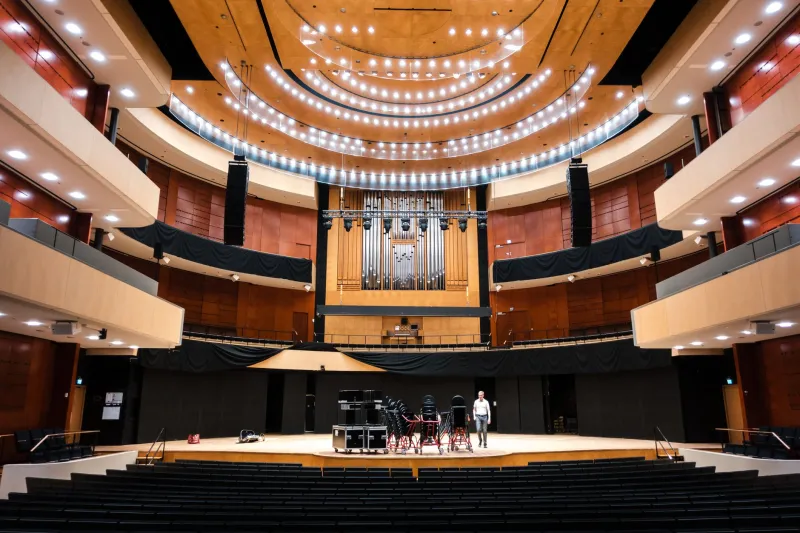
New York's most recent generation of performance spaces has been the direct beneficiary of these advances. The renovation of David Geffen Hall, completed in 2022, stands as perhaps the most visible local example. The project, undertaken by Diamond Schmitt Architects in collaboration with acoustic consultants from Jaffe Holden, involved the wholesale reconstruction of the auditorium interior. The new hall seats approximately 2,200 listeners—roughly 500 fewer than its predecessor—and features a reconfigured "vineyard" seating arrangement that wraps the audience around the stage in terraced sections. The geometry is not merely aesthetic. By placing listeners on multiple sides of the performers and at varying elevations, the design maximizes the lateral reflections that psychoacoustic research associates with a sense of envelopment and spatial richness.
The Vocabulary of Modern Acoustics
To the uninitiated, the language of acoustic engineering can seem remote from the sensory experience of sitting in a darkened hall and hearing a Brahms symphony unfold. Yet the connection is direct and profound. Reverberation time—the duration it takes a sound to decay by sixty decibels after its source ceases—determines, among other things, whether a hall feels intimate or cathedral-like, dry or lush. For orchestral repertoire, a mid-frequency reverberation time of between 1.8 and 2.2 seconds is generally considered ideal; chamber music and solo recital work tends to favor slightly shorter values that preserve textural clarity.
Acousticians also attend closely to what they call early reflections: sound waves that reach a listener within approximately thirty milliseconds of the direct sound from the stage. When these early reflections arrive from lateral directions—from the walls beside and behind the audience—the human auditory system interprets the result as a sense of being surrounded by, rather than merely in front of, the music. Achieving this effect in a large hall requires careful calibration of wall angles, surface materials, and the placement of diffusing elements such as convex panels and geometric protrusions that scatter sound rather than focusing it.
At the newly reconfigured National Sawdust in Williamsburg, a smaller but architecturally ambitious venue, the approach is necessarily different. Designed with a flexible interior that can be reconfigured for everything from new-music premieres to intimate song cycles, the space employs variable acoustic panels and electronically assisted resonance systems that allow its technical staff to tune the room's sonic character to the demands of each program. This adaptability represents a frontier of contemporary acoustic design: rather than optimizing a hall for a single purpose, engineers are developing systems that can shift parameters in real time.
Democratizing the Premium Experience
The gains achieved in flagship venues raise an uncomfortable question that the classical music community in New York has not always been willing to confront directly. If the finest acoustic experiences are concentrated in spaces whose ticket prices reflect the considerable capital invested in their construction and renovation, does the science of sound ultimately serve a narrow audience?
The concern is not hypothetical. A full renovation of the scale undertaken at David Geffen Hall carries a price tag measured in hundreds of millions of dollars—figures that are accessible only to institutions with substantial endowments and powerful donor networks. Smaller presenters operating in repurposed lofts, neighborhood churches, and community centers—the venues that bring classical music to listeners who may never set foot in Lincoln Center—are working with entirely different material realities. Acoustic treatment in a converted warehouse typically means modest interventions: heavy curtains, movable panels, and the strategic placement of sound-absorbing materials that can reduce problematic reflections without transforming the fundamental character of the space.
Some practitioners argue that this gap is narrowing, if slowly. The cost of digital acoustic modeling software has fallen dramatically over the past decade, placing sophisticated simulation tools within the reach of mid-sized architectural firms. Organizations such as the Acoustical Society of America increasingly publish research that small-venue operators can apply without engaging elite consulting firms. And a growing cohort of acousticians has made it a professional priority to work with community-oriented presenters at reduced rates, treating the improvement of neighborhood venues as a form of civic engagement.
What the Audience Actually Hears
Perhaps the most significant shift in contemporary acoustic thinking is a renewed emphasis on the listener rather than the performer as the primary subject of design. For much of the twentieth century, concert hall acoustics were evaluated largely from the stage outward: musicians complained about dead spots, excessive brightness, or insufficient feedback from the room, and adjustments were made accordingly. The newer paradigm places equal or greater weight on what the audience member in seat J-14 actually perceives—a perspective that has been shaped in part by the proliferation of high-fidelity home audio equipment, which has conditioned listeners to expect a level of sonic detail and spatial coherence that older halls sometimes struggle to provide.
This shift has practical consequences. At David Geffen Hall, the renovation team conducted extensive listening tests with audience members seated throughout the new configuration before finalizing certain design decisions, treating the public's subjective responses as data points alongside the objective measurements gathered by acoustic instruments. The methodology reflects a broader trend toward what designers sometimes call evidence-based acoustic design—an approach that treats the concert experience as something to be studied and optimized rather than simply inherited from tradition.
A City Still Listening
New York remains, by any measure, one of the world's great cities for classical music, and its newest performance spaces suggest that the ambition driving that reputation has not diminished. The science has grown more precise, the tools more powerful, and the understanding of what listeners need more nuanced than at any previous moment in the city's musical history. Whether those advances translate into a genuinely more inclusive sonic landscape—one in which a concertgoer in the South Bronx has access to acoustic conditions as carefully considered as those at Lincoln Center—remains an open and urgent question. The revolution in sound design is real. Its reach, for now, is still being measured.