The Open Door: Rethinking How We Welcome New Listeners into the Classical Tradition
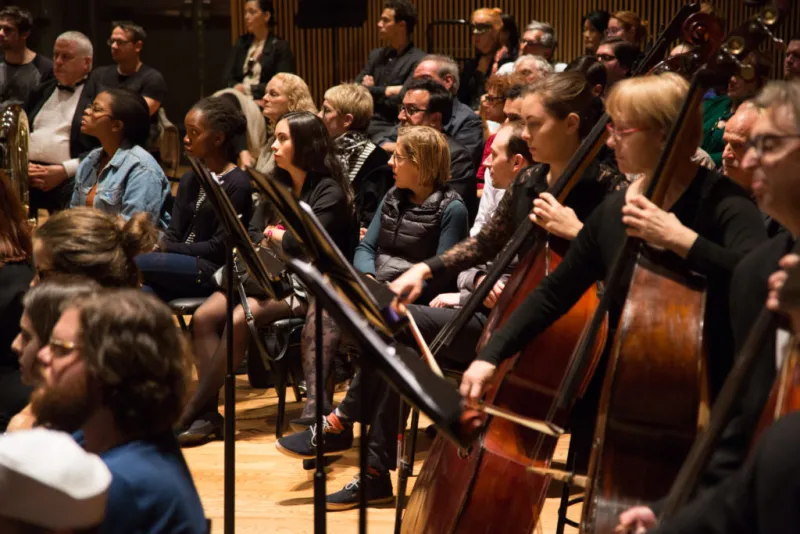
Photo: diverse young audience classical music concert New York, via www.arts-ny.com
Let us begin with an honest admission: classical music has not always been kind to beginners.
For much of the twentieth century, the standard introduction to the repertoire came bundled with an implicit set of demands. One was expected to sit still and silent, to refrain from applauding between movements, to arrive having already absorbed some measure of historical context, and to approach the music with a gravity bordering on reverence. The unspoken message to the uninitiated was clear enough: this is not for everyone, and if you are uncertain whether it is for you, perhaps it is not.
The consequences of that posture are visible in concert hall demographics across the country. Audience surveys conducted by major American orchestras consistently reveal aging subscriber bases and persistent barriers to entry among younger and more diverse populations. New York, for all its cultural vitality, is not immune to these pressures. The question facing the city's classical institutions is not whether change is necessary—that debate has largely been settled—but how to pursue it without sacrificing the depth and rigor that make this tradition worth protecting in the first place.
The answer, increasingly, is to lead with joy.
The Problem with Prerequisites
Conventional wisdom once held that classical music appreciation required a foundation in music theory—that without understanding sonata form, the circle of fifths, or the distinction between a symphony and a concerto, a listener could not fully engage with the repertoire. This assumption, while well-intentioned, has proven to be one of the more effective barriers the classical world has erected against its own growth.
Consider what it actually means to hear Beethoven's Seventh Symphony for the first time without any theoretical preparation. The second movement's relentless, hypnotic pulse; the way the finale seems to accelerate beyond what the human body can contain; the sheer physical energy of the whole—none of this requires a single vocabulary word to be felt. Wagner famously described that symphony as the apotheosis of the dance. He was not speaking to musicologists. He was describing a visceral, immediate experience available to anyone willing to listen.
The problem is not that music theory is irrelevant—it is a rich and rewarding discipline that deepens engagement over time. The problem is presenting it as a prerequisite rather than a destination. Asking a newcomer to study harmony before attending a concert is roughly equivalent to requiring a prospective theatergoer to read Aristotle's Poetics before seeing their first play. The sequence, to put it plainly, is backward.
What New York Is Getting Right
Several New York institutions have begun experimenting with formats that prioritize emotional engagement over intellectual credentialing, and the results are instructive.
The New York Philharmonic's Open Rehearsal series has long provided an entry point that feels less freighted than a formal concert. Without the full apparatus of a ticketed evening—the dress codes, the programmatic notes, the social pressure to respond correctly—first-time listeners often find themselves responding more freely and, paradoxically, more deeply. The music is the same. The permission to simply experience it, without performance anxiety of their own, makes all the difference.
Smaller organizations across the five boroughs have pursued similar instincts with considerable creativity. Chamber music series in Brooklyn and Queens have experimented with pre-concert conversations that frame the music through narrative rather than analysis—telling the story of a composer's life or the circumstances under which a particular work was written, then inviting the audience to hear those circumstances in the music. This approach does not dumb the material down. It provides a human entry point that theoretical explanation rarely offers.
The storytelling impulse is not a departure from classical tradition; it is a return to it. Haydn's symphonies carry nicknames—The Surprise, The Clock, The Farewell—precisely because their original audiences understood music through story and image. The analytical framework came later, imposed by a pedagogical culture that mistook one mode of engagement for the only legitimate one.
Joy as a Serious Proposition
There is a risk, in advocating for accessibility, of appearing to argue for superficiality. It is worth being direct: joy is not the enemy of depth. It is, in most cases, the precondition for it.
A listener who attends a performance of Schubert's Winterreise and is moved to tears by the final song—without knowing what a Lied is, without understanding the formal relationship between voice and piano—has had a genuine and significant musical experience. That experience is the foundation on which deeper knowledge can be built, if the listener chooses to pursue it. The knowledge, in this sequence, serves the experience. It does not replace it.
New York's classical community is particularly well-positioned to model this approach because the city's cultural life is constitutionally pluralistic. New Yorkers arrive at their enthusiasms from every conceivable direction—through film scores, through jazz, through world music traditions, through the incidental exposure of living in a city where music is everywhere. Meeting listeners where they are, rather than insisting they arrive at a prescribed starting point, is not a concession to populism. It is simply good pedagogy.
A Practical Guide for the Curious Newcomer
For those standing at the threshold of this tradition, uncertain where to begin, a few straightforward suggestions may be useful.
Start with what moves you emotionally. If a piece of music produces a physical response—a quickening of the breath, a sudden stillness, the inexplicable urge to weep—that response is data. Follow it. Read about the composer afterward, if you wish. But the feeling came first, and it is trustworthy.
Seek out annotated programs and pre-concert talks. Many New York venues offer these resources, and they are designed precisely for the listener who wants context without a graduate seminar. Carnegie Hall's Neighborhood Concerts series and Lincoln Center's various community programming initiatives are excellent starting points.
Give yourself permission to have preferences. Not all classical music will speak to every listener, and that is entirely appropriate. Deciding that you prefer Romantic-era orchestral works to Baroque keyboard music is not a failure of taste—it is the beginning of one. Preferences, examined and refined over time, are how a personal relationship with music develops.
Attend with someone who loves it. Enthusiasm is contagious, and a knowledgeable companion who shares their excitement without condescension is worth more than any printed guide. The classical music community in New York, at its best, is generous with its passion.
The Tradition Belongs to Everyone
Classical music has survived wars, revolutions, economic catastrophe, and the relentless churn of popular taste. It has done so not because it was protected by gatekeepers, but because it contains something that human beings across centuries and cultures have found indispensable—a capacity for beauty, complexity, and emotional truth that few other art forms can match.
That capacity does not diminish when a new listener encounters it without formal preparation. If anything, the unmediated encounter—the moment when someone hears the Adagio from Barber's Violin Concerto or the opening of Dvořák's New World Symphony for the first time and simply stops—is among the most powerful arguments the tradition can make for itself.
New York's classical institutions are at their finest when they trust that argument. The music, given the chance to speak directly, has always been its own best advocate.